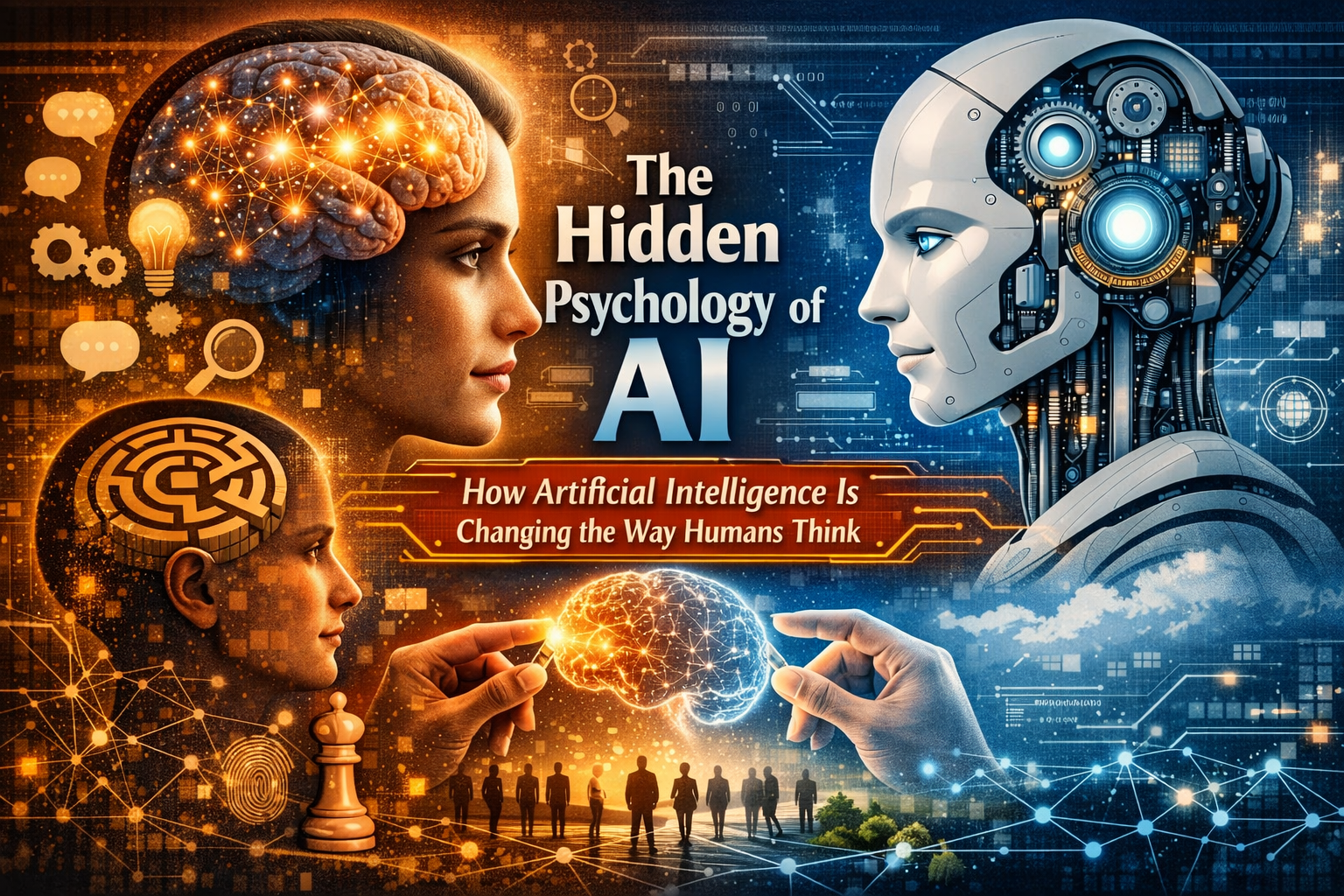
Artificial Intelligence is not just changing technology — it is quietly transforming how humans think, learn, and make decisions.
While most discussions focus on jobs, tools, or automation, very few people talk about the psychological impact of AI on human behavior.
This article explores how AI is reshaping human thinking patterns and what it means for students and future professionals.
🧩 What Is “AI Psychology”?
AI psychology refers to how humans interact with, depend on, and adapt to intelligent systems.
Unlike traditional tools, AI:
✔ responds like humans
✔ gives instant answers
✔ adapts to user behavior
✔ simulates intelligence
👉 This creates a unique relationship between humans and machines.
🧠 1. Reduced Cognitive Effort (The “Thinking Less” Effect)
AI tools provide instant answers, which reduces the need for deep thinking.
Example:
Instead of solving a problem manually, students may ask AI for the answer directly.
Impact:
✔ faster learning
❌ reduced problem-solving skills (if misused)
👉 AI can make us efficient — but also mentally dependent.
⚡ 2. Instant Gratification Culture
AI delivers results in seconds.
This creates a habit where people:
✔ expect quick answers
✔ avoid long processes
✔ lose patience for deep learning
👉 Students may struggle with subjects that require sustained effort.
🧠 3. Shift from Memorization to Understanding
Earlier education focused on memorizing information.
Now with AI:
✔ information is always available
✔ focus shifts to understanding concepts
👉 This is a positive transformation in learning.
🤖 4. Human-AI Trust Development
People are starting to trust AI decisions.
Examples:
✔ relying on AI for coding
✔ trusting AI for writing
✔ using AI suggestions in decision-making
Risk:
Blind trust without verification.
👉 Critical thinking becomes more important than ever.
🎯 5. Decision-Making Dependency
AI assists in decision-making:
✔ career suggestions
✔ study plans
✔ content creation
Over time, people may:
❌ rely too much on AI
❌ lose independent thinking ability
👉 Balance is key.
🧠 6. Shortened Attention Span
AI-generated summaries and short answers reduce:
✔ reading time
✔ attention span
People prefer:
✔ quick insights
✔ short content
👉 Deep reading habits are decreasing.
🌍 7. AI and Creativity: Enhancement or Replacement?
AI can generate:
✔ images
✔ articles
✔ code
✔ designs
Question:
Is AI replacing creativity or enhancing it?
Reality:
👉 AI enhances creativity if used as a tool
👉 It replaces creativity if used as a shortcut
🎓 What This Means for Students
Students must adapt to AI without becoming dependent.
Smart approach:
✔ use AI for understanding
✔ verify information
✔ practice problem-solving
✔ think independently
🚀 Skills Needed in the AI Era
To stay ahead, students must develop:
✔ critical thinking
✔ creativity
✔ problem-solving ability
✔ decision-making skills
✔ AI literacy
👉 These cannot be replaced by AI.
⚠️ The Biggest Risk: Passive Thinking
The biggest danger is not AI — it is passive thinking.
If students stop thinking and rely entirely on AI:
❌ learning becomes shallow
❌ skills weaken
❌ creativity declines
🎯 Final Thoughts
Artificial Intelligence is transforming not just industries but the human mind itself.
The future belongs to people who:
✔ use AI as a tool
✔ not as a replacement for thinking
✔ balance speed with understanding
👉 AI should assist intelligence — not replace it.