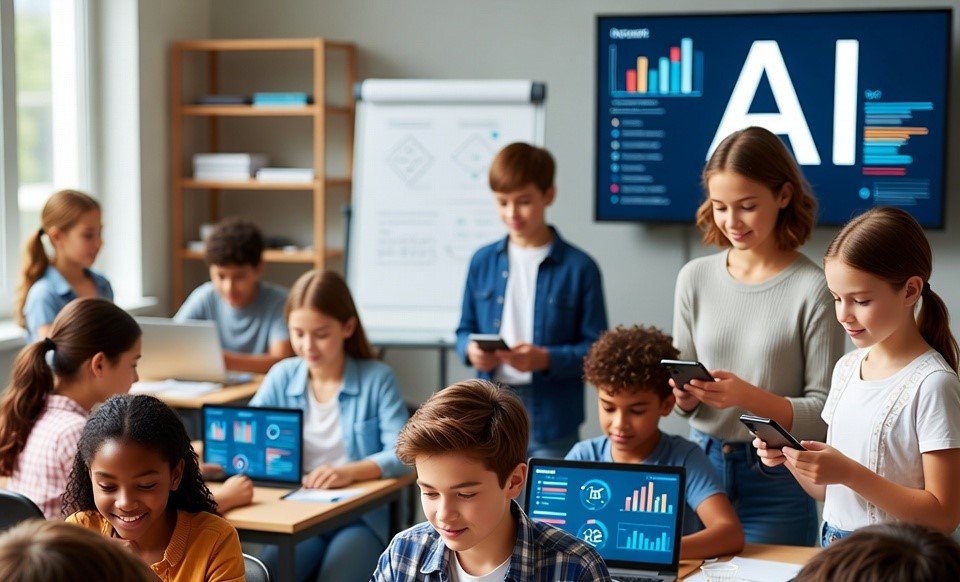
Artificial Intelligence is rapidly transforming almost every industry in the world, and education is no exception. In classrooms, libraries, online courses, coaching centers, and even during exam preparation, students are increasingly relying on AI-powered tools to study, solve problems, write assignments, prepare presentations, and improve productivity.
What once seemed like futuristic technology has now become a daily academic companion for millions of students worldwide.
Today, students can ask AI systems to:
- Explain difficult concepts
- Solve mathematical problems
- Summarize chapters
- Generate assignments
- Create presentations
- Write code
- Prepare interview answers
- Translate languages
- Generate notes instantly
Tasks that previously required hours of research can now be completed in just a few minutes.
This sudden rise of AI in education has triggered an important global debate:
Is Artificial Intelligence helping students become smarter learners, or is it making them overly dependent on technology?
The answer is not simple. AI has enormous educational potential, but it also introduces serious challenges related to critical thinking, originality, creativity, and long-term learning habits.
This article explores how AI is transforming education, why students prefer AI-powered learning, the benefits and dangers of AI dependence, how teachers are responding, and what the future of AI-driven education may look like.
The Silent AI Revolution in Education
Education is currently experiencing one of the biggest technological shifts in history.
Unlike previous educational technologies such as calculators, projectors, or online videos, AI systems actively interact with students. They can answer questions, generate explanations, personalize learning experiences, and simulate tutoring in real time.
This has created what many experts describe as a “silent AI revolution.”
Unlike major public transformations, this shift is happening quietly. Students are adopting AI tools independently without formal institutional changes.
Many students now use AI daily for:
- Homework assistance
- Coding support
- Research summaries
- Presentation preparation
- Essay writing
- Exam revision
- Career guidance
AI adoption has become especially popular because modern tools are:
- Fast
- Free or affordable
- Available 24/7
- Easy to use
- Mobile-friendly
The barrier to accessing advanced educational assistance has almost disappeared.
Why Students Prefer AI Over Traditional Learning Methods
One of the biggest reasons behind AI adoption is convenience.
Traditional learning often requires:
- Searching multiple books
- Reading lengthy articles
- Watching long lectures
- Waiting for teacher guidance
- Spending hours understanding concepts
AI drastically reduces this effort.
Students can now type a question and receive instant explanations within seconds.
This speed and accessibility make AI extremely attractive.
Instant Results and Faster Learning
Modern students are growing up in a digital environment where speed matters.
AI tools provide:
- Immediate answers
- Quick summaries
- Step-by-step solutions
- Simplified explanations
For example, instead of spending one hour researching a topic manually, a student can:
- Ask AI for a summary
- Request important points
- Generate examples
- Create notes instantly
This saves enormous time during:
- Exams
- Assignment deadlines
- Project preparation
As academic pressure increases, students naturally gravitate toward faster solutions.
Simplified Explanations for Difficult Topics
Many students struggle because textbooks often use:
- Technical language
- Complex terminology
- Dense explanations
AI tools simplify learning by explaining concepts in:
- Simple English
- Conversational language
- Step-by-step formats
- Personalized examples
For instance, a student confused about:
- Quantum physics
- Programming concepts
- Calculus
- Economics
can ask AI to explain the topic “like a beginner” or “in simple words.”
This adaptive communication style makes AI highly effective as a learning assistant.
Personalized Learning Experiences
Traditional classrooms usually follow a single teaching pace for all students.
However, every student learns differently.
Some students:
- Learn quickly
- Need visual explanations
- Prefer practical examples
- Require repeated clarification
AI tools adapt more flexibly to individual needs.
Students can:
- Ask unlimited questions
- Repeat concepts multiple times
- Learn privately without embarrassment
- Study at their own speed
This creates a personalized learning experience that traditional classrooms sometimes struggle to provide.
AI as a 24/7 Tutor
One major limitation of traditional education is availability.
Teachers are available only during:
- School hours
- Coaching sessions
- Scheduled classes
AI tools are available continuously.
Students can study:
- Late at night
- Early morning
- During travel
- On weekends
This accessibility is especially valuable for:
- Rural students
- Working students
- Competitive exam aspirants
- Online learners
AI effectively acts as a constant digital tutor.
How Students Are Using AI Today
AI is now integrated into almost every stage of student learning.
1. Assignment Writing
Students use AI to:
- Generate essays
- Create reports
- Write summaries
- Improve grammar
This significantly reduces writing time.
2. Exam Preparation
AI helps students:
- Generate practice questions
- Create revision notes
- Explain difficult concepts
- Summarize chapters
Many students use AI during last-minute exam preparation.
3. Coding and Programming
Computer science students increasingly rely on AI for:
- Writing code
- Debugging programs
- Explaining algorithms
- Learning new programming languages
AI coding assistants have become extremely popular.
4. Presentation Creation
AI tools can now:
- Generate PowerPoint slides
- Suggest designs
- Create visuals
- Produce presentation scripts
Students can prepare professional presentations much faster.
5. Career Guidance
Students also use AI for:
- Resume writing
- Interview preparation
- Career advice
- Skill recommendations
AI is becoming a digital mentor for many learners.
The Hidden Concern: Are Students Thinking Less?
Despite its advantages, AI raises an important concern.
Many educators worry that students may become too dependent on AI systems instead of developing genuine understanding.
This concern is becoming increasingly serious.
Some students now:
- Copy AI-generated answers directly
- Submit assignments without reading
- Avoid solving problems independently
- Skip critical thinking processes
As a result, they may complete tasks successfully without truly learning.
This creates a dangerous illusion of knowledge.
The Problem of Passive Learning
Real learning requires active mental engagement.
Students develop intelligence through:
- Practice
- Mistakes
- Analysis
- Reflection
- Problem-solving
However, overdependence on AI can encourage passive learning.
Instead of struggling with a difficult problem and learning through effort, students may immediately ask AI for the answer.
While this improves speed, it may reduce:
- Deep understanding
- Long-term memory retention
- Analytical thinking
- Creativity
Learning becomes consumption instead of exploration.
Critical Thinking Under Threat
Critical thinking is one of the most important skills in modern education.
It involves:
- Evaluating information
- Asking questions
- Analyzing arguments
- Solving unfamiliar problems
- Making independent decisions
If students rely excessively on AI-generated responses, they may stop questioning information critically.
This is dangerous because AI systems are not always correct.
AI can sometimes:
- Generate inaccurate facts
- Provide misleading explanations
- Produce biased information
- Confidently present wrong answers
Students who blindly trust AI may lose the habit of verification and independent reasoning.
The Risk of Academic Dependency
Dependency develops when students feel unable to complete tasks without AI assistance.
This can become problematic during:
- Competitive exams
- Job interviews
- Real-world challenges
- Practical problem-solving situations
In real life, students may face situations where:
- Instant AI help is unavailable
- Independent thinking is required
- Creativity matters more than automation
Overdependence may weaken confidence in one’s own abilities.
Teachers Are Beginning to Notice the Change
Educators across the world are already observing significant changes in student behavior.
Teachers report:
- Faster assignment submissions
- Better formatting and presentation quality
- Improved grammar
- More polished reports
However, they also notice:
- Reduced originality
- Similar writing styles
- Superficial understanding
- Lack of depth in discussions
Some students struggle to explain assignments they submitted themselves.
This indicates that AI-generated work does not always reflect actual comprehension.
Educational Institutions Are Adapting
Schools and universities are slowly adapting to AI-driven education.
Many institutions are:
- Updating academic policies
- Introducing AI ethics discussions
- Redesigning assessments
- Encouraging project-based learning
Some universities now allow AI-assisted learning under specific guidelines.
Others are introducing:
- Oral evaluations
- Practical assessments
- AI detection systems
- Critical analysis assignments
Education systems are entering a transition phase.
Smart Students Use AI Differently
Not all students misuse AI.
In fact, highly successful learners often use AI in very intelligent ways.
Smart students use AI to:
- Understand concepts deeply
- Clarify doubts
- Explore alternative explanations
- Improve productivity
- Enhance creativity
They treat AI as:
A learning assistant, not a replacement for thinking.
This distinction is extremely important.
AI as a Productivity Tool
Students who use AI wisely gain enormous advantages.
AI can help them:
- Save time
- Organize study plans
- Generate revision material
- Learn faster
- Focus on important concepts
Instead of spending hours on repetitive work, they can focus more on:
- Understanding
- Creativity
- Application
- Innovation
This balanced approach produces better educational outcomes.
The Importance of Verification
One key habit smart students develop is verification.
They:
- Cross-check AI responses
- Compare multiple sources
- Validate important facts
- Think critically about outputs
This prevents blind dependence.
AI should assist human intelligence — not replace it.
How AI Is Changing Traditional Education
AI is reshaping education in several major ways.
1. Shift From Memorization to Understanding
Traditionally, education focused heavily on memorization.
However, since AI can instantly retrieve information, future education may focus more on:
- Understanding concepts
- Applying knowledge
- Solving real-world problems
Memorization alone is becoming less valuable.
2. Personalized Learning Paths
Future AI systems may create fully customized learning journeys.
Students could receive:
- Personalized lessons
- Adaptive quizzes
- Skill-based recommendations
- Individual learning speeds
This could improve educational effectiveness significantly.
3. AI Tutors and Virtual Classrooms
Future classrooms may include:
- AI tutors available 24/7
- Interactive AI teaching assistants
- Real-time feedback systems
- Intelligent educational analytics
AI could provide support beyond what traditional classrooms can offer.
4. Language and Accessibility Support
AI also improves educational accessibility.
Students can:
- Translate lessons instantly
- Learn in native languages
- Access simplified explanations
- Use speech-based learning tools
This benefits students with:
- Language barriers
- Learning disabilities
- Limited educational resources
The Future Job Market and AI Skills
Another important reason students are using AI is career preparation.
Future workplaces will increasingly require:
- AI literacy
- Prompt engineering
- Automation understanding
- Digital productivity skills
Students who learn how to use AI responsibly may gain competitive advantages in:
- Technology
- Marketing
- Research
- Business
- Design
- Content creation
AI skills are becoming part of future-ready education.
Ethical Concerns in AI Education
The rapid growth of AI also raises ethical concerns.
1. Academic Integrity
Should students submit AI-generated assignments as their own work?
This question is becoming increasingly controversial.
Educational institutions are struggling to define fair AI usage policies.
2. Plagiarism and Originality
AI-generated content may reduce originality if students rely too heavily on automated writing.
Creativity and personal expression remain essential educational values.
3. Inequality in AI Access
Not all students have equal access to advanced AI tools.
This may create new forms of educational inequality.
Students with better technology access could gain significant advantages.
The Biggest Mistake Students Must Avoid
The biggest mistake students can make is:
Using AI without thinking independently.
Students should never:
- Blindly copy answers
- Skip understanding concepts
- Avoid practice
- Depend entirely on automation
AI should support thinking, not eliminate it.
The Right Way to Use AI in Education
Students can use AI effectively by following balanced learning strategies.
✔ Use AI to Understand Concepts
Ask AI for:
- Explanations
- Examples
- Clarifications
- Simplified summaries
But always try to understand the reasoning.
✔ Practice Independently
After learning with AI:
- Solve problems manually
- Write answers independently
- Test personal understanding
Practice strengthens real knowledge.
✔ Verify Important Information
Always cross-check:
- Facts
- Calculations
- Academic references
- Technical concepts
AI can sometimes produce errors confidently.
✔ Combine Traditional Learning With AI
Books, teachers, discussions, and practical exercises remain extremely valuable.
The best learning happens when:
- Human teaching
- Critical thinking
- AI assistance
work together.
The Future of Education in the AI Era
Education is entering a new phase.
AI will likely become:
- A standard classroom tool
- A personalized tutor
- A productivity assistant
- A research companion
However, human intelligence, creativity, ethics, and critical thinking will remain essential.
The future will not belong to students who simply use AI.
It will belong to students who know:
- When to use AI
- How to question AI
- How to think beyond AI
Final Verdict
Artificial Intelligence is transforming education faster than any previous technology. It is helping students learn faster, access knowledge instantly, improve productivity, and personalize learning experiences.
For many students, AI has become an incredibly powerful educational companion.
However, the real challenge is not the existence of AI itself.
The real challenge is:
How students choose to use it.
Students who use AI wisely can:
- Learn more efficiently
- Develop future-ready skills
- Improve creativity
- Stay competitive in the digital world
But students who rely on AI blindly may:
- Lose critical thinking abilities
- Weaken problem-solving skills
- Become dependent on automation
- Struggle in real-world situations
AI should enhance human intelligence — not replace it.
The future of education will belong not to those who avoid AI, but to those who combine AI with independent thinking, curiosity, creativity, and genuine understanding.
In the end, success in the AI era depends on one simple principle:
Use AI as a tool for learning, not as a substitute for thinking.