India is witnessing one of the biggest technological employment transformations in its modern history. While global discussions around Artificial Intelligence (AI) have often focused on automation, job displacement, and uncertainty, a different story is unfolding across India. The country is now experiencing record-breaking growth in AI-related employment, with emerging cities like Vijayawada rapidly entering the national technology landscape.
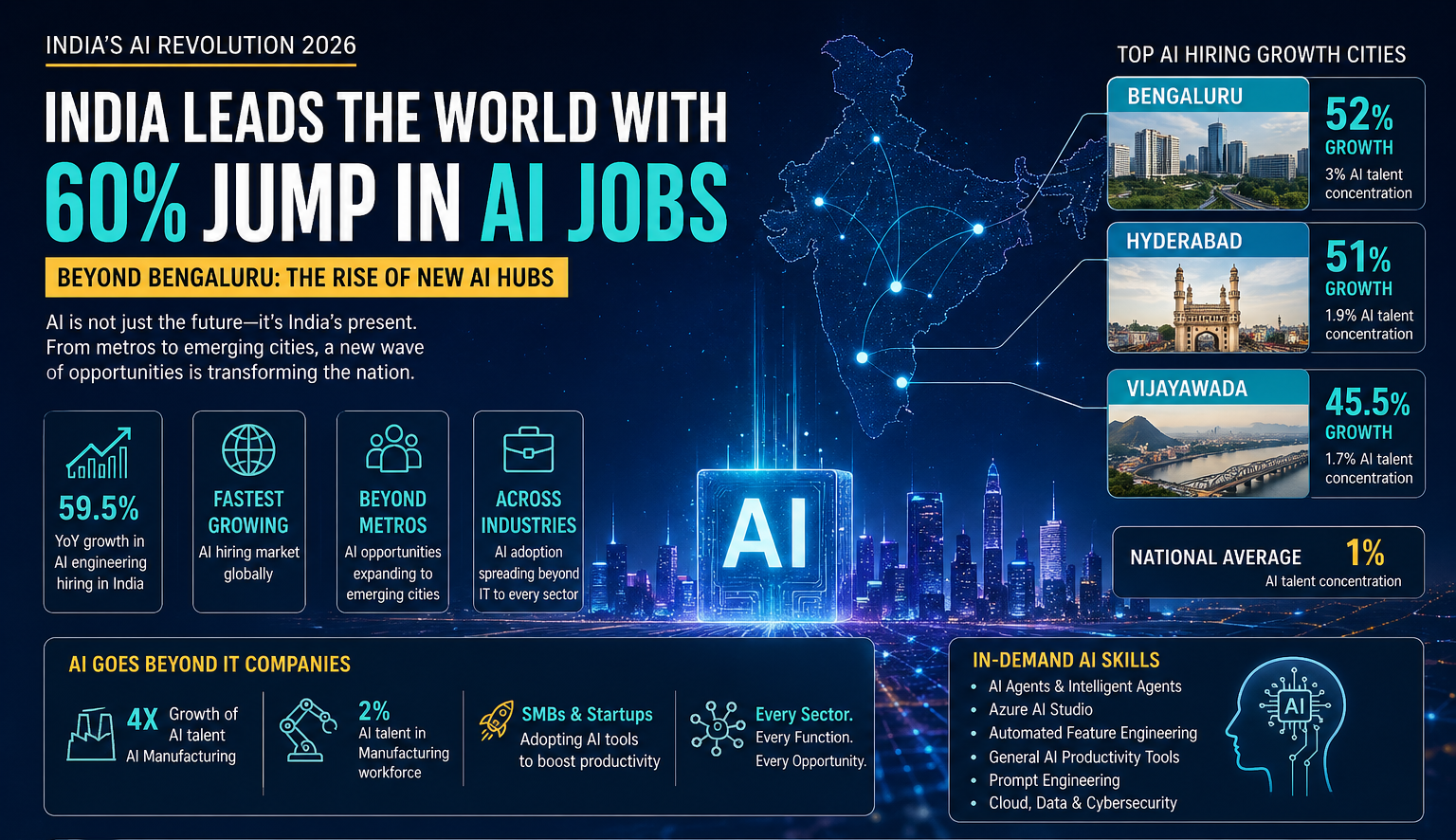
Recent industry reports and hiring trends indicate that India has recorded nearly 60% year-on-year growth in AI engineering hiring, making it the fastest-growing AI job market among major economies. The growth is not limited to traditional technology hubs such as Bengaluru and Hyderabad. Instead, the AI boom is expanding into Tier-2 cities and educational ecosystems that were previously considered outside India’s mainstream technology corridor.
Among the most surprising and promising developments is the emergence of Vijayawada as a rising AI talent destination. Once known primarily as an educational and commercial center in Andhra Pradesh, the city is now beginning to gain attention for its growing AI talent concentration, digital education initiatives, and increasing relevance in the country’s evolving technology economy.
This transformation marks a major shift in India’s employment landscape and opens new opportunities for students, institutions, startups, and industries preparing for the future of work.
India Leads the World in AI Hiring Growth
Artificial Intelligence is no longer a futuristic concept discussed only in research laboratories or multinational companies. It has become a central force shaping modern business operations, software development, healthcare, manufacturing, finance, education, retail, and government services.
As AI adoption accelerates worldwide, India has emerged as one of the most active countries in developing AI talent.
According to recent industry hiring reports, India recorded approximately 59.5% growth in AI engineering hiring over the past year. This growth rate surpasses many advanced economies, including the United States, the United Kingdom, Germany, and France.
Experts believe several factors are contributing to India’s rapid AI expansion:
-
A large young workforce.
-
Increasing access to digital infrastructure.
-
Affordable internet connectivity.
-
Growth in cloud computing.
-
Rising startup activity.
-
Expansion of AI-focused education.
-
Adoption of AI tools by businesses of all sizes.
For many years, India’s technology growth revolved around software services, outsourcing, and IT support industries. However, the current AI wave represents a transition from traditional IT operations to intelligent systems, automation platforms, machine learning applications, and AI-driven productivity solutions.
This shift is creating an entirely new category of employment opportunities.
Beyond the Fear: AI Is Also Creating Jobs
For several years, global conversations around Artificial Intelligence were dominated by fears that machines would replace human workers. Many people worried that AI would eliminate careers in software development, business operations, customer support, and even creative industries.
While automation is undoubtedly changing certain traditional roles, the current Indian job market tells a more balanced story.
AI is not only replacing repetitive tasks.
It is also creating:
-
New engineering roles.
-
AI deployment positions.
-
Intelligent automation careers.
-
AI-assisted business operations.
-
Data analysis opportunities.
-
Cloud and infrastructure jobs.
-
AI product development roles.
-
Prompt engineering positions.
-
AI integration and workflow management careers.
Industry leaders now emphasize that the future workforce will not simply compete against AI systems. Instead, professionals who learn how to work alongside AI tools will become significantly more valuable.
This has changed the definition of employability.
In the past, companies mainly searched for candidates with theoretical degrees or traditional coding skills. Today, employers increasingly prefer professionals who can:
-
Solve real-world problems using AI.
-
Automate workflows.
-
Integrate AI tools into applications.
-
Build intelligent systems.
-
Improve productivity through AI platforms.
-
Deploy AI solutions in business environments.
The hiring market is evolving from theoretical knowledge toward practical execution.
Bengaluru Still Leads India’s AI Ecosystem
Despite the expansion into newer regions, Bengaluru continues to dominate India’s technology economy.
The city remains the country’s largest AI hiring center and has maintained more than 50% growth in AI engineering recruitment. Bengaluru’s AI talent concentration is now being compared to global technology ecosystems such as San Francisco.
Several reasons explain Bengaluru’s continued dominance:
-
Presence of global technology companies.
-
Strong startup ecosystem.
-
Advanced venture capital networks.
-
Availability of experienced engineers.
-
Access to cloud and AI infrastructure.
-
Established innovation culture.
Major multinational corporations continue investing heavily in AI research and product development in Bengaluru. The city hosts thousands of startups working in:
-
Generative AI.
-
Automation systems.
-
Robotics.
-
Healthcare AI.
-
Financial technology.
-
Cybersecurity.
-
Cloud infrastructure.
-
AI-driven analytics.
However, Bengaluru’s success has also created new challenges.
Rapid growth has increased:
-
Salary competition.
-
Infrastructure pressure.
-
Operational costs.
-
Traffic congestion.
-
Real estate expenses.
-
Talent retention difficulties.
As a result, many companies are now exploring emerging cities where skilled talent is available at lower operational costs.
This shift is opening doors for cities like Vijayawada.
Hyderabad Strengthens Its Position
Hyderabad has also become one of India’s fastest-growing AI ecosystems.
The city has experienced more than 50% growth in AI-related hiring and continues attracting technology investments from both Indian and international companies.
Hyderabad’s growth has been driven by:
-
Strong IT infrastructure.
-
Government support for technology industries.
-
Expansion of data centers.
-
Presence of major software companies.
-
Startup-friendly environment.
-
AI-focused research and innovation.
The city is increasingly becoming a preferred destination for companies seeking alternatives to Bengaluru while still maintaining access to high-quality technical talent.
Hyderabad’s rise also demonstrates an important national trend:
India’s AI future is becoming multi-city rather than concentrated in a single technology capital.
Vijayawada Emerges as a New AI Growth Story
Perhaps the most surprising development in India’s AI employment landscape is the emergence of Vijayawada.
Traditionally recognized as a commercial, educational, and cultural hub in Andhra Pradesh, Vijayawada is now beginning to appear in national discussions related to AI talent growth.
Recent hiring reports indicate that Vijayawada recorded approximately 45.5% growth in AI job postings.
More importantly, the city’s AI talent concentration has risen above the national average.
This is a significant achievement for a Tier-2 city.
The rise of Vijayawada reflects several broader changes occurring across India.
Why Vijayawada Is Becoming Attractive for AI Growth
1. Strong Educational Ecosystem
Vijayawada and surrounding regions have seen rapid expansion in higher education institutions offering:
-
Artificial Intelligence.
-
Data Science.
-
Computer Science.
-
Cloud Computing.
-
Analytics.
-
Application Development.
-
Business Intelligence.
-
Machine Learning.
Students are increasingly gaining exposure to:
-
AI tools.
-
Coding platforms.
-
Cloud systems.
-
Automation technologies.
-
Real-time projects.
-
Industry certifications.
This educational expansion is helping create a new generation of technology-ready graduates.
2. Lower Operational Costs
Compared to Bengaluru and Hyderabad, Vijayawada offers:
-
Lower office rental costs.
-
Affordable infrastructure.
-
Reduced employee living expenses.
-
Lower salary inflation.
-
Better operational scalability for startups.
For companies seeking sustainable growth, emerging cities provide economic advantages while still offering access to skilled talent.
This allows organizations to reduce expenses without compromising technological capability.
3. Remote and Hybrid Work Revolution
The post-pandemic work culture transformed how technology companies operate.
AI development teams now frequently collaborate through:
-
Cloud-based systems.
-
Distributed development environments.
-
Remote communication tools.
-
Virtual deployment pipelines.
-
Online project management systems.
Because of this, companies no longer need every engineer to work from a major metro city.
What matters today is:
-
Skill.
-
Productivity.
-
Problem-solving capability.
-
Execution ability.
-
Adaptability.
This shift has created enormous opportunities for talented students from Tier-2 cities.
4. Andhra Pradesh’s Digital Expansion
Andhra Pradesh has also been increasing its focus on:
-
AI governance.
-
Data infrastructure.
-
Digital transformation.
-
Technology-driven administration.
-
Innovation ecosystems.
Discussions around AI-powered public services, digital education systems, and large-scale technology investments are contributing to growing confidence in the region’s future.
As infrastructure expands, cities like Vijayawada are expected to benefit significantly.
The Most In-Demand AI Skills in 2026
One of the biggest changes in the technology industry is the shift away from purely theoretical hiring.
Companies now seek professionals who can apply AI practically.
Among the most in-demand skills are:
AI Agents and Intelligent Systems
Businesses increasingly want AI systems capable of:
-
Automating tasks.
-
Assisting decision-making.
-
Managing workflows.
-
Handling customer interactions.
-
Generating reports.
-
Performing intelligent analysis.
AI agents are expected to become one of the defining technologies of the coming decade.
Azure AI Studio and Cloud AI Platforms
Cloud-based AI development has become essential.
Organizations now depend heavily on platforms such as:
-
Microsoft Azure AI.
-
Google Cloud AI.
-
AWS AI Services.
-
Open-source AI ecosystems.
Professionals who understand cloud-based deployment and AI integration are in high demand.
Automated Feature Engineering
Modern machine learning systems increasingly rely on automated data processing and feature optimization.
Companies are searching for engineers capable of:
-
Handling data pipelines.
-
Improving model performance.
-
Automating machine learning workflows.
-
Managing large-scale datasets.
AI Productivity Tools
AI-powered productivity systems are transforming workplaces.
Employees now use AI tools for:
-
Content generation.
-
Data analysis.
-
Software development.
-
Workflow automation.
-
Research assistance.
-
Presentation building.
-
Customer support.
-
Documentation.
Organizations want professionals who know how to effectively use these tools to improve efficiency.
AI Is Expanding Beyond Software Companies
Another important trend is that AI adoption is no longer limited to technology firms.
Today, industries across the economy are integrating AI into daily operations.
Manufacturing
Manufacturing companies are using AI for:
-
Predictive maintenance.
-
Quality control.
-
Supply chain optimization.
-
Industrial automation.
-
Smart factory systems.
AI talent in manufacturing has reportedly grown multiple times over recent years.
Healthcare
Hospitals and healthcare startups are implementing AI for:
-
Medical imaging.
-
Diagnostic assistance.
-
Patient management.
-
Predictive healthcare.
-
Drug research.
Education
Educational institutions are using AI for:
-
Personalized learning.
-
Smart assessment systems.
-
Virtual tutors.
-
Automated evaluation.
-
Student analytics.
Agriculture
Agricultural technology companies are exploring AI for:
-
Crop monitoring.
-
Irrigation optimization.
-
Weather prediction.
-
Soil analysis.
-
Smart farming.
Banking and Finance
Financial institutions now depend heavily on AI for:
-
Fraud detection.
-
Risk analysis.
-
Automated support systems.
-
Customer analytics.
-
Investment forecasting.
This widespread adoption means AI-related careers are no longer restricted to software engineering alone.
Students from multiple academic backgrounds can participate in the AI economy.
The Changing Role of Educational Institutions
As AI reshapes industry expectations, educational institutions are facing growing pressure to modernize curriculum structures.
Traditional theory-only approaches are becoming insufficient.
Experts increasingly recommend that institutions focus on:
-
Practical training.
-
Industry projects.
-
Internship exposure.
-
Cloud technologies.
-
AI deployment systems.
-
Real-world problem solving.
-
Automation workflows.
-
AI-assisted development.
Students must gain hands-on experience rather than relying only on textbook knowledge.
This is particularly important for programs such as:
-
BSc Artificial Intelligence.
-
BSc Data Science.
-
BCA.
-
Computer Science.
-
BBA Analytics.
-
BCom Computer Applications.
Industry leaders now value graduates who can demonstrate project capability, adaptability, and practical understanding of AI tools.
Startups and the New AI Economy
India’s startup ecosystem is also playing a major role in AI expansion.
Thousands of startups are building products related to:
-
AI automation.
-
Content generation.
-
Smart analytics.
-
Healthcare AI.
-
Educational technology.
-
Customer intelligence.
-
AI-powered commerce.
-
Financial technology.
Many of these startups no longer need massive physical infrastructure.
Cloud computing and remote collaboration allow smaller teams to operate from emerging cities while serving national and global markets.
This creates enormous opportunities for young entrepreneurs from Tier-2 regions.
Students are increasingly launching:
-
AI service companies.
-
Automation agencies.
-
SaaS platforms.
-
Data analytics firms.
-
AI consulting startups.
-
Productivity tool businesses.
The startup economy is becoming one of the strongest drivers of AI employment.
The Global Competition for AI Talent
The worldwide race for AI leadership has intensified dramatically.
Countries across the globe are investing billions into:
-
AI research.
-
Semiconductor development.
-
Cloud infrastructure.
-
Data centers.
-
AI regulations.
-
Digital transformation.
India’s advantage lies in its combination of:
-
Young population.
-
Technical education base.
-
Expanding internet access.
-
Strong software ecosystem.
-
Rapid digital adoption.
If India successfully develops large-scale AI talent, it could become one of the world’s most important AI workforce providers.
This possibility explains why educational institutions, governments, and industries are now prioritizing AI-focused skill development.
Challenges Still Remain
Despite the optimism, experts caution that several challenges must still be addressed.
Skill Gap
Many students continue learning outdated curriculum structures that do not align with current industry needs.
There remains a significant gap between:
-
classroom education
and -
practical industry execution.
Infrastructure Limitations
Tier-2 cities still require stronger:
-
digital infrastructure
-
high-performance computing access
-
startup support systems
-
AI research ecosystems
-
industry partnerships
Faculty Development
Educational institutions must also invest in continuous faculty upskilling so teachers remain aligned with rapidly evolving technologies.
Ethical and Responsible AI
As AI adoption grows, concerns around:
-
privacy
-
bias
-
misinformation
-
job displacement
-
cybersecurity
-
data governance
must also be addressed responsibly.
Experts stress that AI growth should remain ethical, transparent, and human-centered.
A Historic Opportunity for Students
For today’s students, the AI revolution represents one of the biggest career opportunities of the modern era.
However, success will depend on adaptability.
Students who focus only on theoretical learning may struggle in the changing market.
Those who develop practical capability in:
-
AI tools
-
automation
-
cloud systems
-
analytics
-
software development
-
intelligent workflows
-
problem solving
-
digital productivity
are expected to remain highly valuable.
The future workforce will likely consist of professionals who understand how to combine human creativity with AI-powered efficiency.
This makes continuous learning more important than ever before.
Vijayawada’s Moment in India’s AI Future
The emergence of Vijayawada as an AI growth destination symbolizes a larger national transformation.
India’s technology future is no longer restricted to a few metropolitan centers.
Instead, opportunity is spreading across:
-
emerging cities
-
educational ecosystems
-
regional innovation hubs
-
digitally connected communities
For students in Andhra Pradesh and surrounding regions, this shift creates a powerful message:
World-class technology opportunities are becoming increasingly accessible without necessarily relocating to traditional metro cities.
As AI adoption continues accelerating, cities capable of producing skilled, adaptable, and industry-ready talent will become increasingly important.
Vijayawada now appears to be positioning itself as one of those emerging centers.
Conclusion
India’s AI revolution has entered a defining phase.
The country is witnessing record-breaking growth in AI engineering hiring, rapid expansion of intelligent technologies, and a transformation in how industries operate.
Most importantly, the growth is spreading beyond traditional technology capitals.
The rise of Vijayawada as an emerging AI talent hub demonstrates that India’s digital future is becoming more decentralized, inclusive, and opportunity-driven.
For students, institutions, and businesses, the message is clear:
The future belongs not merely to those who understand Artificial Intelligence in theory, but to those who can apply it effectively in the real world.
As the AI era continues reshaping the global economy, India—and cities like Vijayawada—may play a far bigger role than many once imagined.