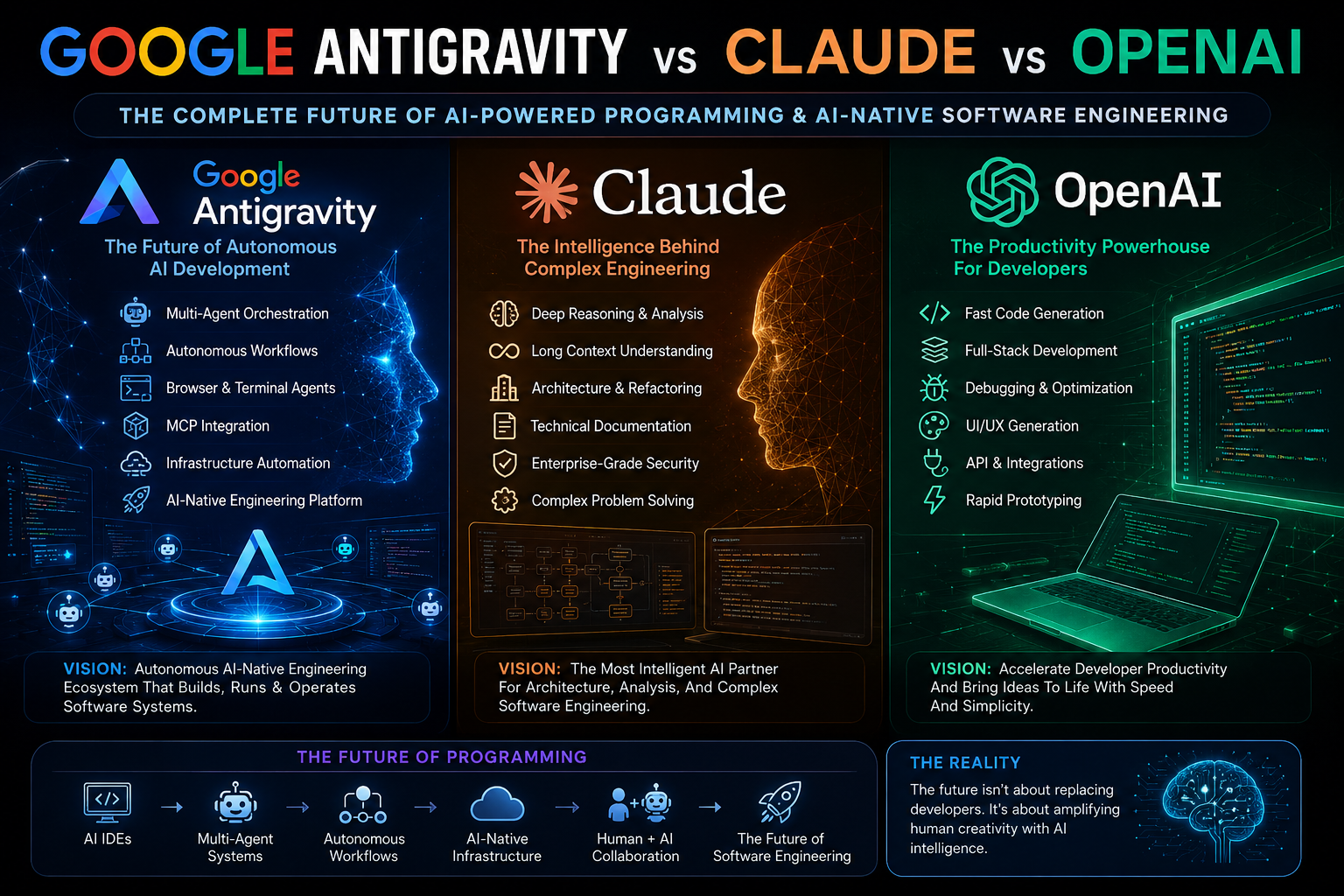
Artificial Intelligence is fundamentally transforming software engineering at a speed never witnessed before in the history of computing. For decades, programming depended entirely on human effort. Developers manually designed architectures, wrote backend logic, debugged applications, managed servers, optimized databases, deployed infrastructure, and maintained software systems. Even after the rise of modern frameworks and cloud computing, human engineers still remained responsible for almost every critical engineering decision and operational workflow.
Today, that reality is changing dramatically.
Artificial Intelligence is no longer limited to autocomplete suggestions or simple coding assistance. Modern AI systems can now generate entire applications, build APIs, design user interfaces, analyze repositories, optimize performance, write documentation, perform browser testing, execute terminal commands, coordinate multiple autonomous agents, and even manage complex engineering workflows.
The software industry is entering a completely new era:
AI-Native Software Engineering
At the center of this transformation are three powerful ecosystems:
- Google Antigravity
- Anthropic Claude
- OpenAI OpenAI ChatGPT
Although many people compare these platforms directly, they are not merely competing chatbots. Each represents a completely different vision of the future of software development itself.
OpenAI focuses on maximizing developer productivity through AI-assisted coding. Claude focuses on reasoning, architecture, long-context understanding, and technical intelligence. Google Antigravity introduces something far more ambitious: autonomous AI-driven software engineering systems capable of orchestrating workflows across browsers, terminals, editors, and cloud infrastructure.
This transformation raises enormous questions for the entire technology industry. Which platform is best for programming? Will AI replace developers? How should startups use AI? What happens to software engineering jobs? What is the future of enterprise development? How will autonomous AI agents change programming itself?
Understanding these platforms is no longer optional for modern developers. It is becoming essential for:
- Students
- Freelancers
- Startup founders
- Enterprise engineers
- Cloud architects
- DevOps teams
- CTOs
- Product engineers
- AI researchers
The developers who learn how to work effectively with these systems today may define the next generation of the software industry itself.
The Historical Evolution of Programming
To understand why platforms like OpenAI, Claude, and Antigravity are so important, it is necessary to understand how programming evolved over time.
In the early era of computing, software engineering was almost entirely manual. Developers worked directly with low-level programming languages, memory management, hardware constraints, and infrastructure configuration. Building even relatively simple applications required significant engineering effort. Teams often spent months or years building systems that today could be prototyped within days.
Programming in that era required extensive expertise in:
- Algorithms
- Data structures
- Hardware optimization
- Operating systems
- Networking
- Database management
The process was slow, expensive, and highly specialized.
As computing evolved, software frameworks began reducing repetitive engineering work. Technologies such as object-oriented programming, modern databases, reusable libraries, web frameworks, and cloud platforms dramatically accelerated development. Frameworks like React, Angular, Laravel, Django, Spring Boot, and Node.js enabled developers to focus more on application logic rather than low-level infrastructure.
Cloud computing further transformed the industry by introducing scalable infrastructure platforms such as AWS, Google Cloud, Azure, and Firebase. Developers no longer needed to manage physical servers directly. Deployment became faster, scalability improved, and startup costs decreased significantly.
However, despite all these advancements, software engineering still depended fundamentally on human developers. Humans designed architectures, wrote logic, managed workflows, debugged systems, and coordinated projects.
Artificial Intelligence is now transforming that model completely.
The Rise of AI-Assisted Programming
The first generation of AI-assisted development tools focused mainly on autocomplete and syntax suggestions. These systems could predict likely code sequences but did not deeply understand programming logic or project architecture.
The emergence of large language models changed this dramatically.
Modern AI systems understand:
- Natural language
- Programming syntax
- Framework relationships
- Software architecture patterns
- API design
- Documentation structure
Developers can now describe software requirements conversationally and receive functioning implementations within seconds.
Instead of manually searching documentation, developers can ask:
“Create a responsive student management dashboard using React, Tailwind CSS, Node.js, and PostgreSQL with role-based authentication and analytics.”
AI systems can generate:
- Frontend components
- Backend APIs
- Database schemas
- Authentication logic
- Validation systems
- Responsive layouts
- Deployment configurations
This transformation fundamentally changes software development economics.
OpenAI and the Productivity Revolution
OpenAI became the dominant force in AI-assisted programming because it dramatically increased developer productivity.
Official Website: OpenAI
ChatGPT transformed AI from an experimental research concept into practical development infrastructure used daily by millions of programmers around the world.
Developers now use OpenAI extensively for:
- Web development
- Mobile applications
- API development
- Database optimization
- DevOps automation
- UI generation
- Testing
- Documentation
- AI integrations
OpenAI’s biggest strength is speed. It enables developers to move from concept to implementation extremely quickly.
A startup founder can now describe an application idea in natural language and receive a functioning prototype within hours rather than weeks. This dramatically lowers the barrier to entrepreneurship.
Freelancers use OpenAI to accelerate client delivery. Students use it to learn programming concepts interactively. Enterprises use it to automate repetitive engineering tasks.
The productivity gains are enormous.
How Developers Actually Use OpenAI
Modern developers rarely use OpenAI simply as a chatbot. Instead, they integrate it deeply into development workflows.
Frontend developers use OpenAI for:
- Responsive layouts
- Component generation
- Tailwind CSS styling
- Animation systems
- UI prototyping
Backend developers use it for:
- API creation
- Authentication systems
- Database relationships
- Validation logic
- Error handling
DevOps engineers use it for:
- Docker configurations
- CI/CD pipelines
- Kubernetes YAML generation
- Infrastructure scripting
Students use it for:
- Learning algorithms
- Understanding syntax
- Building projects
- Debugging assignments
This versatility is one of OpenAI’s biggest advantages.
OpenAI and Startup Ecosystems
OpenAI may have changed startup culture more dramatically than any recent technology.
Historically, startups required:
- Backend developers
- Frontend engineers
- Designers
- DevOps specialists
- QA teams
AI dramatically reduces these requirements.
A small AI-assisted engineering team can now produce software that previously required large organizations.
This creates:
Hyper-Leverage Startups
Small teams can build:
- SaaS platforms
- AI tools
- Mobile applications
- E-commerce systems
- Automation services
with unprecedented speed and efficiency.
This is one reason venture capital firms are increasingly investing heavily in AI-native startups.
The Importance of Prompt Engineering
One of the most important modern development skills is:
Prompt Engineering
AI systems depend heavily on instruction quality.
A weak prompt such as:
“Create website.”
will usually produce generic results.
A detailed prompt such as:
“Build a responsive AI-powered college admissions portal using Next.js, Tailwind CSS, Node.js, PostgreSQL, JWT authentication, dark mode, analytics dashboard, mobile responsiveness, SEO optimization, and animated UI.”
produces dramatically better outputs.
Developers who master prompt engineering gain significant productivity advantages.
Prompt engineering is rapidly becoming part of modern software engineering itself.
The Weaknesses of OpenAI
Despite its strengths, OpenAI still has important limitations.
AI-generated code may:
- Contain security vulnerabilities
- Hallucinate APIs
- Use outdated frameworks
- Produce inconsistent architecture
- Forget project context
This means human oversight remains critical.
Experienced developers still provide:
- Security analysis
- Architecture decisions
- Product logic
- Performance optimization
- Infrastructure planning
AI accelerates developers but does not eliminate the need for engineering expertise.
Claude and the Rise of AI Software Architecture
Anthropic approaches programming differently from OpenAI.
Official Website: Claude AI
Where OpenAI prioritizes implementation speed, Claude prioritizes:
- Reasoning
- Context understanding
- Structure
- Maintainability
- Architectural intelligence
Claude often feels less like a coding assistant and more like a senior technical architect.
Its biggest strength is deep contextual understanding.
Large enterprise repositories often contain:
- Millions of lines of code
- Legacy infrastructure
- Complex dependencies
- Multiple microservices
- Technical debt
Claude excels at analyzing:
- System relationships
- Scalability concerns
- Architectural weaknesses
- Refactoring opportunities
- Dependency structures
This makes Claude extremely valuable in enterprise environments.
Claude and Enterprise Engineering
Large organizations care about more than just implementation speed.
They prioritize:
- Scalability
- Reliability
- Maintainability
- Governance
- Documentation
Claude performs exceptionally well in these areas.
Developers frequently use Claude for:
- Architecture planning
- Technical documentation
- Refactoring analysis
- Infrastructure reasoning
- Dependency analysis
For example, a developer might upload multiple services and ask:
“Analyze this architecture and identify scalability bottlenecks.”
Claude can explain:
- Service coupling problems
- Database limitations
- Caching opportunities
- API design improvements
- Infrastructure weaknesses
This level of reasoning makes Claude highly valuable for advanced engineering teams.
Claude and Technical Documentation
Another major strength of Claude is technical writing quality.
Engineering organizations often struggle with documentation because developers prioritize coding over writing.
Claude helps generate:
- API documentation
- Architecture summaries
- Technical reports
- Engineering specifications
- Refactoring plans
Its outputs are usually:
- Well-structured
- Clear
- Maintainable
- Professional
This improves team communication significantly.
Claude’s Limitations
Claude is powerful for reasoning but less optimized for rapid implementation workflows.
Compared to OpenAI:
- It may overanalyze problems
- Produce slower UI generation
- Focus more on theory
- Generate less visually polished frontend designs
For startup MVP development, OpenAI often feels faster and more practical.
For architecture and large-scale analysis, Claude often feels superior.
Google Antigravity and the Future of Autonomous Engineering
Google Antigravity represents one of the most ambitious visions in modern software engineering.
Official Documentation: Google Antigravity Docs
Unlike OpenAI and Claude, Antigravity is not primarily designed as a conversational assistant.
It is designed as:
- An autonomous engineering platform
- A multi-agent development system
- An AI orchestration environment
This distinction changes everything.
The Shift from AI Assistance to AI Execution
Traditional AI systems operate reactively.
The workflow is:
- Human asks question
- AI generates response
- Human executes workflow
Antigravity introduces a different model:
- Human assigns objective
- AI agents coordinate execution
- AI systems operate tools
- Human supervises outcomes
This is the beginning of:
Autonomous AI Engineering
Multi-Agent Engineering Systems
One of Antigravity’s most revolutionary concepts is multi-agent orchestration.
Instead of relying on a single AI assistant, multiple AI agents can work simultaneously.
For example:
- One agent builds frontend UI
- Another writes backend APIs
- Another performs testing
- Another monitors infrastructure
- Another handles deployment
This introduces:
AI Engineering Teams
rather than individual AI assistants.
This concept could fundamentally reshape software organizations.
Browser Agents and Operational Intelligence
Antigravity agents can directly interact with browsers.
This enables AI systems to:
- Open dashboards
- Fill forms
- Validate workflows
- Test applications
- Monitor systems
This is extremely important for:
- QA automation
- End-to-end testing
- Enterprise operations
Traditional AI systems mostly generate information.
Antigravity begins operating systems directly.
Terminal Integration and Infrastructure Automation
Antigravity agents can also operate terminals.
They can:
- Execute shell commands
- Install dependencies
- Run deployments
- Execute tests
- Analyze logs
This transforms AI from:
- Information generator
into:
Infrastructure operator
This is a major technological leap.
MCP and the Infrastructure Layer of AI Engineering
One of Antigravity’s most important technologies is MCP (Model Context Protocol).
Official Docs: Google Antigravity MCP Documentation
MCP allows AI systems to connect directly with:
- Databases
- APIs
- GitHub
- Monitoring tools
- Cloud infrastructure
- Enterprise systems
Instead of manually copying context into chat windows, AI agents can access systems directly.
This creates:
AI-Native Infrastructure
where autonomous systems coordinate software workflows dynamically.
Google’s Long-Term Vision
Most people think Google is competing with OpenAI simply on chatbot quality.
That is not the full picture.
Google appears to be building:
The operating system layer for AI-native software engineering.
This includes:
- Gemini models
- Antigravity
- Managed agents
- MCP infrastructure
- AI Studio
- Autonomous workflows
This ecosystem could become foundational for enterprise AI operations.
OpenAI vs Claude vs Antigravity
The comparison between these platforms is not simply about which writes better code.
Each platform excels in different domains.
OpenAI dominates:
- Rapid coding
- Full-stack implementation
- Startup productivity
- Frontend generation
- Practical development speed
Claude dominates:
- Architecture reasoning
- Documentation
- Refactoring
- Enterprise analysis
- Large-context understanding
Antigravity dominates:
- Autonomous workflows
- AI orchestration
- Multi-agent systems
- Infrastructure automation
- AI-native operations
The future may involve combining all three systems strategically.
The Emergence of AI-Native Developers
A completely new type of software engineer is emerging:
The AI-Native Developer
These developers:
- Use AI continuously
- Coordinate multiple systems
- Automate repetitive engineering
- Focus on architecture and product thinking
- Build significantly faster than traditional workflows
This may become the dominant programming model of the next decade.
The Future of Programming Careers
Programming careers are changing fundamentally.
Future developers will increasingly focus on:
- AI orchestration
- System architecture
- Infrastructure intelligence
- Product strategy
- Human-AI collaboration
Routine implementation work may become heavily automated.
However, human expertise remains essential for:
- Creativity
- Innovation
- Security
- Ethical oversight
- Strategic thinking
- Business understanding
AI does not eliminate engineering expertise.
Instead, it amplifies high-level engineering capabilities
Will AI Replace Programmers?
This is one of the most important questions in the technology industry.
The answer is nuanced.
AI will automate many repetitive programming tasks, including:
- Boilerplate code
- Documentation
- Testing assistance
- UI generation
- Infrastructure scripting
However, real software engineering involves:
- Tradeoffs
- Architecture
- Human understanding
- Product design
- Security reasoning
- Business logic
AI accelerates development dramatically, but intelligent human supervision remains critical.
The future is not:
Humans vs AI
The future is: